
Key Help Desk Features For Finance Teams
Discover key help desk features for finance teams. Improve control, tracking, and compliance with the right setup while keeping workflows simple and efficient.

Whether you manage a sprawling enterprise IT department, a fast-scaling SaaS startup, or a lean e-commerce support team, the right help desk software is the operational backbone that keeps customers satisfied and agents effective. This comprehensive guide evaluates the leading platforms, dissects their core features, compares pricing tiers, and helps you make an informed decision.
Help desk software is a centralised platform that receives, organises, prioritises, tracks, and resolves support requests, commonly called tickets, submitted by customers, employees, or end-users. At its most fundamental level it replaces fragmented email inboxes and ad-hoc spreadsheets with a structured workflow, giving every request a unique identifier, an owner, a status, and a documented history.
Modern solutions have evolved far beyond basic ticketing. Today's platforms incorporate artificial intelligence for automated triage, omnichannel inboxes that unify chat, email, phone, and social media, self-service knowledge bases, ITIL-aligned incident management, and deep analytics dashboards, all within a single pane of glass.
A 2024 Gartner survey found that organisations using dedicated help desk platforms resolved tickets 47% faster on average than those relying on shared mailboxes. The downstream effects compound quickly; faster resolution improves satisfaction scores, reduces churn, and lowers cost per ticket. For organisations evaluating the financial case, a help desk ROI calculator can translate these metrics into concrete business numbers before a platform decision is made.
Zendesk remains the gold standard for large organisations that need a highly configurable, omnichannel support platform. Its unified agent workspace aggregates tickets from email, live chat, voice, WhatsApp, and social channels into a single queue, eliminating context-switching.
Zendesk AI, powered by large language models, automatically summarises long ticket threads, suggests knowledge-base articles to agents in real time, and can autonomously resolve straightforward queries through its bot framework. The platform's macro system lets teams create one-click response templates, while its trigger and automation engine handles routing, escalation, and SLA breach alerts without manual intervention.
Best For | Enterprise and mid-market customer support teams |
|---|---|
Key Strengths | Omnichannel inbox, AI copilot, 1,200+ integrations |
Starting Price | $19/agent/month (Suite Team) |
Free Trial | 14 days |
Limitation | Expensive at scale; steep learning curve for complex workflows |
Freshdesk by Freshworks strikes an impressive balance between feature depth and ease of use. Its Freddy AI engine handles ticket classification, response suggestions, and even autonomous resolution of common queries, all without the per-resolution pricing some competitors charge.
The free tier, which supports unlimited agents, makes Freshdesk particularly compelling for early-stage companies. Paid plans layer in time-tracking, custom reports, round-robin assignment, and parent-child ticketing for complex, multi-department issues.
Best For | SMBs and growing support teams seeking rapid deployment |
|---|---|
Key Strengths | Generous free tier, Freddy AI, easy onboarding |
Starting Price | Free (unlimited agents); Growth plan from $15/agent/month |
Free Trial | 21 days on paid plans |
Limitation | Advanced ITIL features require Freshservice upgrade |
Zoho Desk context-aware ticketing places every interaction within the customer's full history, purchases, prior tickets, CRM data, giving agents a 360-degree view without leaving the ticket screen. Its Zia AI assistant analyses ticket sentiment, predicts satisfaction scores, and alerts supervisors when a conversation is heading south.
The platform integrates natively with Zoho CRM, Zoho Analytics, and Zoho Inventory, making it a natural choice for organisations already invested in the Zoho ecosystem. The Blueprint module allows teams to design and enforce multi-step resolution workflows with conditional branching, no coding required.
Best For | Organisations using Zoho CRM or the broader Zoho suite |
|---|---|
Key Strengths | Context-aware ticketing, Zia AI, Blueprint workflows, native CRM integration |
Starting Price | Free (3 agents); Standard from $14/agent/month |
Free Trial | 15 days |
Limitation | UI can feel cluttered; reporting less flexible than Zendesk |
Atlassian Jira Service Management (JSM) is the dominant platform where IT service management meets software development. Its deep integration with Jira Software means that when a customer-reported bug becomes a development ticket, the linkage is seamless, agents see the engineering progress, and developers have full incident context.
JSM supports full ITIL 4 practices including incident, change, problem, and asset management. Its virtual service agent handles common IT requests through conversational AI, while approval workflows ensure that change requests follow governance protocols without creating bottlenecks.
Best For | IT, DevOps, and engineering organisations using Atlassian tools |
|---|---|
Key Strengths | ITIL 4 compliance, Jira Software integration, asset management, change management |
Starting Price | Free (up to 3 agents); Standard from $17.65/agent/month |
Free Trial | 7 days on Premium |
Limitation | Overkill for customer-facing support; complex to configure for non-IT workflows |
HubSpot Service Hub is the only enterprise-grade help desk that lives entirely within a CRM, not integrated with one, but natively built upon the HubSpot CRM. Every ticket, conversation, and survey response enriches the contact record, giving sales, marketing, and support teams a genuinely unified customer view.
Conversation Intelligence transcribes and analyses support calls, surfacing coaching opportunities and tracking topic trends across thousands of interactions. The customer portal allows end-users to log, track, and respond to their own tickets, reducing inbound volume without a dedicated knowledge base build-out.
Best For | Teams wanting CRM-native support with sales and marketing alignment |
|---|---|
Key Strengths | Native CRM, conversation intelligence, customer portal, unified contact record |
Starting Price | Free tier available; Starter from $15/month (2 seats) |
Free Trial | 14 days on paid plans |
Limitation | Full power requires HubSpot CRM adoption across the organisation |
ServiceNow is less a help desk and more a complete enterprise service management platform. It governs IT, HR, legal, finance, and facilities service delivery through a single architecture, making it the platform of choice for Fortune 500 organisations that need unified governance across multiple departments.
Its Now Intelligence AI suite offers predictive analytics, natural language virtual agents, and automated root-cause analysis. The configuration management database (CMDB) provides a living map of every IT asset and its relationships, enabling accurate impact analysis during incidents and change requests.
Best For | Large enterprises with complex, multi-department service management needs |
|---|---|
Key Strengths | Enterprise ITSM, CMDB, Now Intelligence AI, HR and legal service delivery |
Starting Price | Custom pricing (typically $100+/user/month at scale) |
Free Trial | 30-day personal developer instance available |
Limitation | High implementation cost and complexity; requires dedicated admin resources |
Intercom pioneered the messenger-first support paradigm and continues to lead it with Fin, its GPT-4-powered AI agent. Fin resolves over 50% of support queries autonomously across chat, email, and WhatsApp by reasoning over the knowledge base and company documentation, not just pattern-matching FAQs.
For interactions Fin escalates to human agents, the unified inbox provides full conversation context including product usage data pulled from Intercom's built-in customer data platform. The help centre builder supports localisation in 43 languages, making Intercom a strong choice for global SaaS and e-commerce businesses.
Best For | SaaS companies and e-commerce brands prioritising conversational AI support |
|---|---|
Key Strengths | Fin AI agent, messenger-first UX, 43-language help centre, product usage context |
Starting Price | $39/seat/month (Essential); Fin AI from $0.99/resolution |
Free Trial | 14 days |
Limitation | Per-resolution AI pricing can become costly at high volume |
Salesforce Service Cloud delivers enterprise support natively within the world's largest CRM. Einstein AI powers case classification, article recommendations, and next-best-action suggestions, all informed by the complete Salesforce data model including opportunities, contracts, and product history.
Field service management is a native capability, making Service Cloud particularly valuable for organisations that combine remote digital support with on-site technician dispatch. Omni-Channel routing dynamically balances agent workloads across voice, chat, email, and social in real time.
Best For | Enterprises running Salesforce CRM who need unified sales and service data |
|---|---|
Key Strengths | Einstein AI, field service, omni-channel routing, Salesforce data integration |
Starting Price | $25/user/month (Starter Suite) |
Free Trial | 30 days |
Limitation | Full value requires significant Salesforce investment; complex licensing |
LiveAgent combines ticketing, live chat, a call centre, and social media management into one of the most feature-rich packages available below $50 per agent per month. Its gamification system, points, badges, and leaderboards, drives agent engagement, making it a popular choice for BPOs and SMB support teams with high-volume, repetitive ticket workflows.
Best For | SMBs and BPOs needing rich multi-channel support without enterprise pricing |
|---|---|
Key Strengths | Built-in call centre, 200+ integrations, gamification, unlimited ticket history |
Starting Price | Free (limited); Small Business from $9/agent/month |
Free Trial | 30 days |
Limitation | UI feels dated; AI features less mature than top-tier competitors |
Spiceworks Cloud Help Desk remains the most widely deployed free IT help desk globally, with over 280,000 organisations using it to manage internal IT requests. It covers the core ITSM workflow, ticket creation, assignment, status tracking, and reporting, with no per-agent cost, ever.
The trade-off is advertising within the interface and limited advanced features. However, for small IT teams managing internal infrastructure, Spiceworks delivers genuine utility without budget justification.
Best For | Small IT teams and nonprofits needing a zero-cost ITSM solution |
|---|---|
Key Strengths | Completely free, network inventory scanning, mobile app, active community |
Starting Price | Free (ad-supported) |
Free Trial | N/A, always free |
Limitation | Ad-supported; no SLA management; limited automation; not suitable for customer-facing support |
The ticketing system is the operational nucleus of any help desk. Every inbound request, regardless of channel, should be automatically converted into a ticket with a unique identifier, timestamp, and initial classification. Advanced platforms support parent-child ticketing for linking related issues, ticket merging to consolidate duplicates, and custom fields to capture business-specific metadata at the moment of creation.
Customers contact support through whichever channel is most convenient to them. A true omnichannel inbox aggregates email, live chat, WhatsApp, Twitter/X, Facebook Messenger, and voice into a single queue, preserving full conversation history across channel switches so agents never ask a customer to repeat themselves.
Modern AI capabilities have moved far beyond simple keyword-based auto-replies. Leading platforms now offer large-language-model-powered bots that reason over knowledge bases to provide contextually accurate answers, intelligent routing that assigns tickets based on agent expertise and workload, automatic summarisation of long threads, and sentiment analysis that flags at-risk conversations for supervisor intervention.
An effective knowledge base can deflect 20-40% of inbound ticket volume. The best platforms offer SEO-friendly article editors, multi-language support, article versioning, and analytics that reveal which articles successfully resolved queries and which left users unsatisfied, enabling continuous content optimisation.
Service Level Agreements codify resolution commitments. Robust SLA management includes configurable business-hours policies, multi-tier escalation rules, real-time SLA health dashboards, and automated breach notifications, ensuring that no ticket ages past its commitment without appropriate intervention.
Decision-grade reporting includes volume trend analysis, first-contact resolution rates, average handle time, CSAT and NPS tracking, agent performance scorecards, and backlog forecasting. The best platforms allow custom metric definitions, scheduled report delivery, and data export for business intelligence tools.
No help desk operates in isolation. Critical integrations include CRM platforms (Salesforce, HubSpot), communication tools (Slack, Microsoft Teams), e-commerce systems (Shopify, Magento), billing platforms (Stripe, Chargebee), and developer tools (GitHub, PagerDuty). Robust API access and webhook support allow organisations to build custom integrations as their stack evolves.
Selecting a help desk platform is a decision with long-lasting operational implications. The following framework structures the evaluation process:
Define your primary use case: customer-facing support, internal IT, or both.
Audit your current channel mix: if 60% of contacts arrive via chat, prioritise platforms with native live-chat excellence.
Map your integration requirements: list every tool in your current stack and verify native connectors exist.
Assess your AI readiness: generative AI features add significant value but require clean knowledge-base content to function effectively.
Calculate total cost of ownership: factor in per-agent pricing, AI resolution fees, implementation costs, and training time.
Pilot before committing: most vendors offer 14-30 day trials; run a structured pilot with real tickets and real agents.
Evaluate vendor support quality: the irony of poor support from a support-software vendor is not lost on practitioners.
A clear breakdown to help you quickly compare options and pricing at a glance.
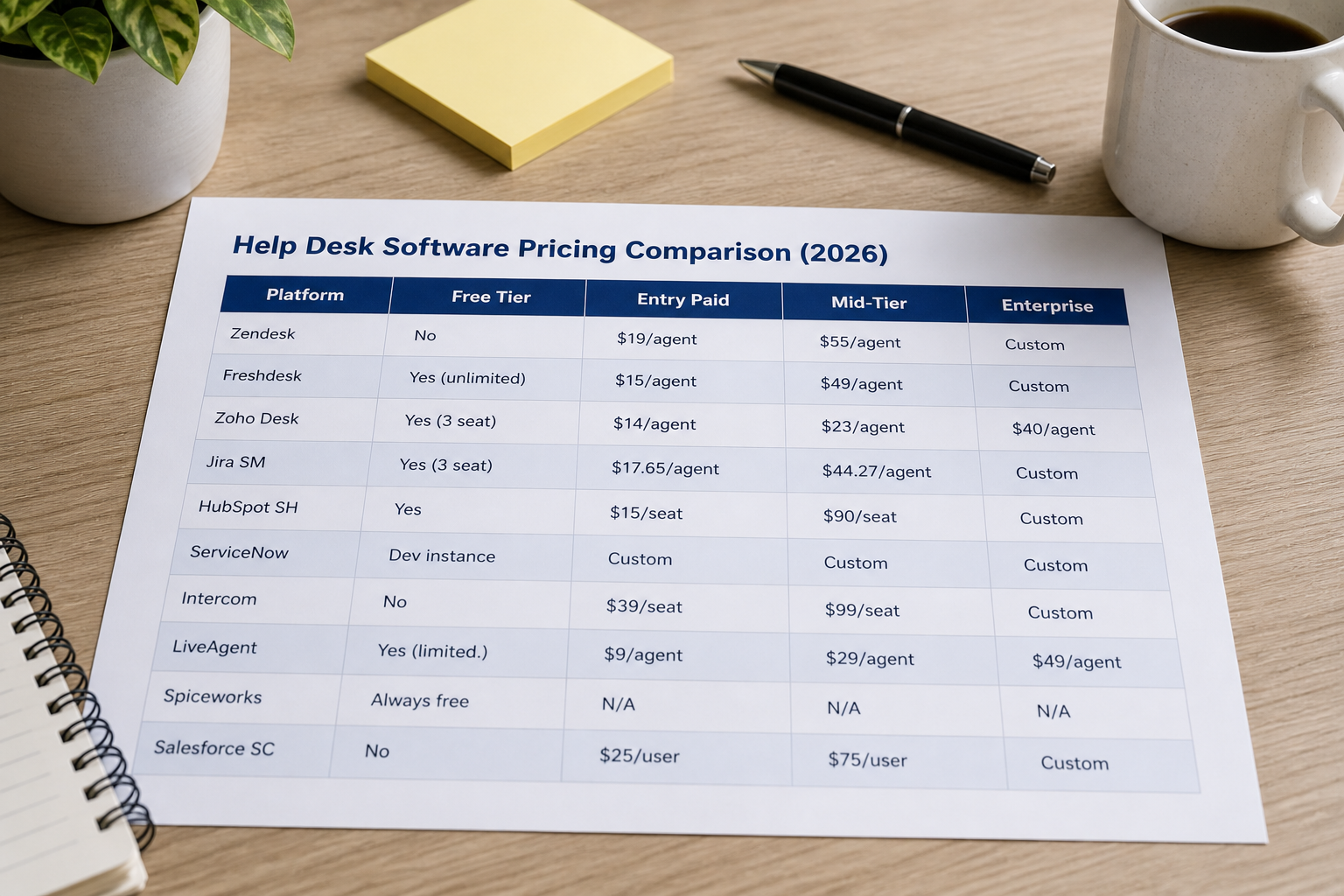
Platform | Free Tier | Entry Paid | Mid-Tier | Enterprise |
|---|---|---|---|---|
Zendesk | No | $19/agent | $55/agent | Custom |
Freshdesk | Yes (unlimited) | $15/agent | $49/agent | Custom |
Zoho Desk | Yes (3 seat) | $14/agent | $23/agent | $40/agent |
Jira SM | Yes (3 seat) | $17.65/agent | $44.27/agent | Custom |
HubSpot SH | Yes | $15/seat | $90/seat | Custom |
ServiceNow | Dev instance | Custom | Custom | Custom |
Intercom | No | $39/seat | $99/seat | Custom |
LiveAgent | Yes (limited.) | $9/agent | $29/agent | $49/agent |
Spiceworks | Always free | N/A | N/A | N/A |
Salesforce SC | No | $25/user | $75/user | Custom |
Use this comparison to identify the tool that fits your budget and feature needs.
Choosing help desk software is one of those decisions that looks straightforward on the surface but carries long-term operational weight. The platform your team works in every day shapes how fast issues get resolved, how agents stay organised, and ultimately how customers experience your brand. This guide cuts through the noise, evaluating 10 leading platforms across features, pricing, and real-world fit so you can make a confident, well-informed decision rather than an expensive one.
There are ROI calculator tools that can help a company estimate data based on publicly available internet data.
Discover key help desk features for finance teams. Improve control, tracking, and compliance with the right setup while keeping workflows simple and efficient.

Learn why help desk systems fail after implementation. Fix adoption issues, improve workflows, and track ROI to get better results from your support setup.
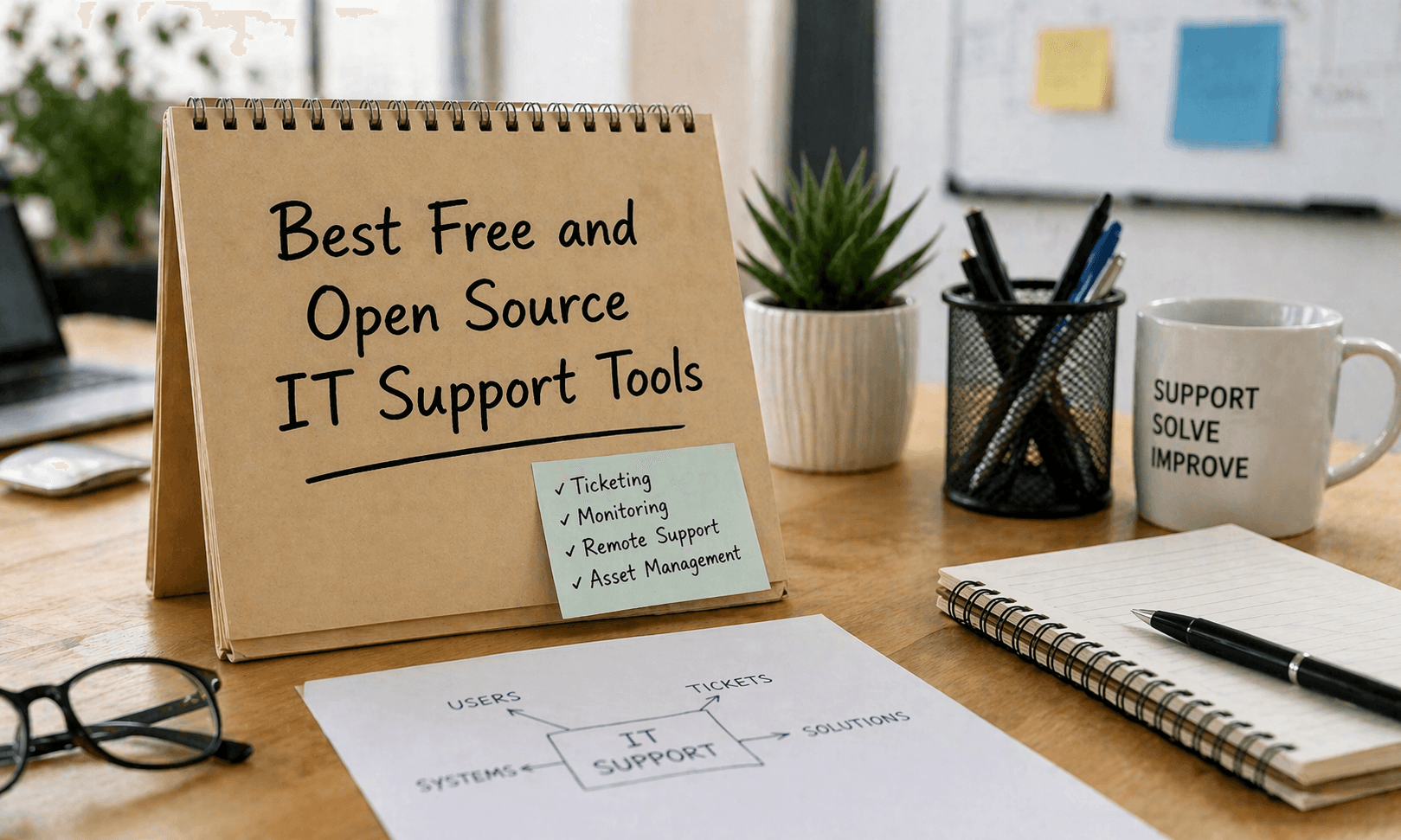
Explore the best free and open source IT support tools for small teams. Manage tickets, monitor systems, and improve workflows without high software costs.

Find the best ticketing software for small IT departments. Compare tools, features, and pricing to manage requests, improve response time, and stay organized.