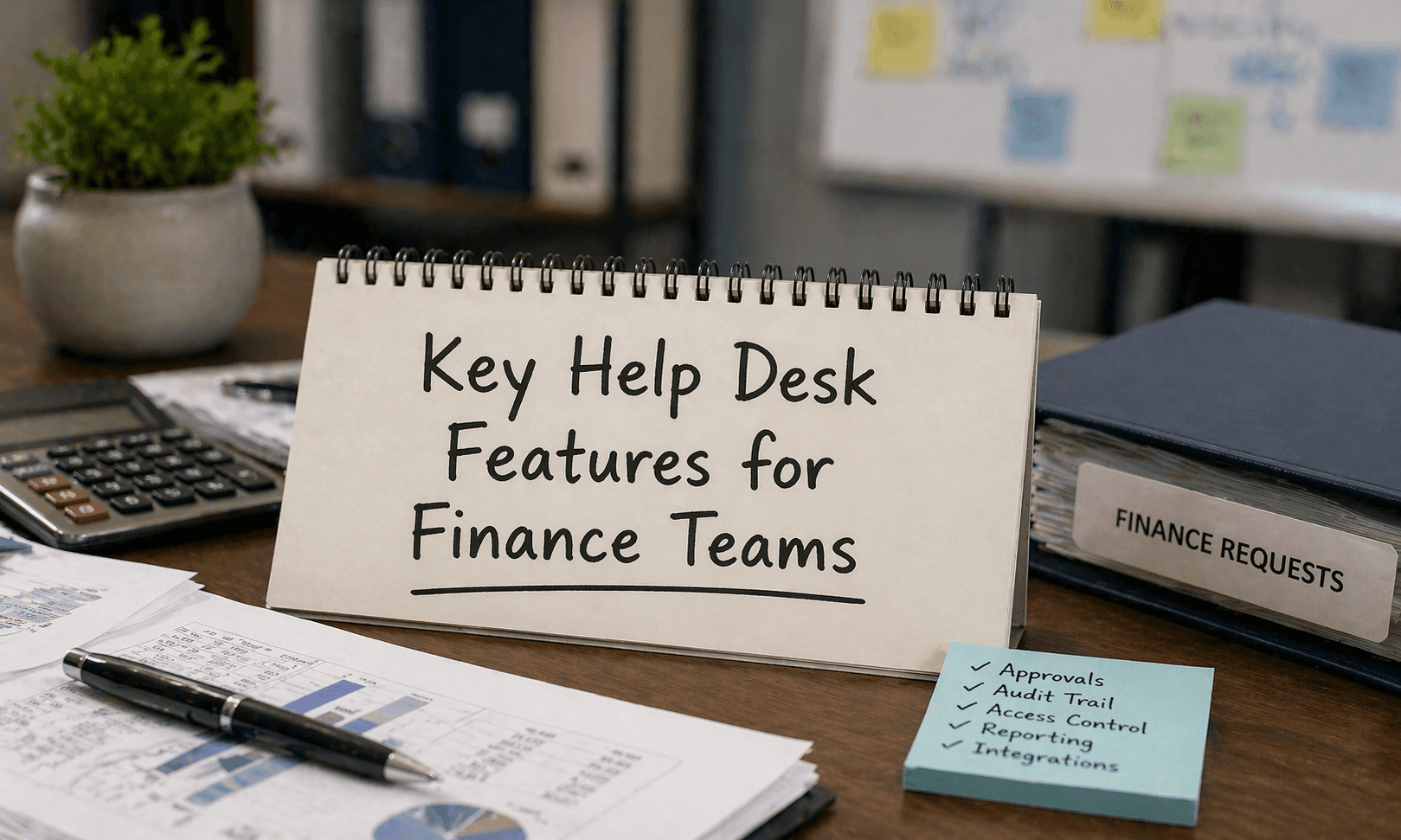
Key Help Desk Features For Finance Teams
Discover key help desk features for finance teams. Improve control, tracking, and compliance with the right setup while keeping workflows simple and efficient.
SaaS companies operate in a fundamentally different support environment than traditional enterprises. Customers are often self-sufficient, technically sophisticated, and acutely aware of subscription alternatives, meaning that a single unresolved or poorly handled support interaction can trigger a cancellation. Help desk software for SaaS must therefore do more than manage tickets: it must actively contribute to retention, product improvement, and revenue growth.
The most effective SaaS help desk platforms share three distinguishing characteristics. First, they integrate natively with product data sources, CRMs, analytics platforms, and in-app event streams, so that every support conversation begins with full customer context. Second, they use AI not merely to automate responses but to detect risk signals: a user who submits three tickets in a week without resolution is statistically more likely to churn, and the best platforms surface that pattern proactively. Third, they close the feedback loop between support and product: structured tagging and reporting ensure that recurring pain points are quantified and routed to engineering roadmaps rather than buried in agent notes.
Most help desk software was built for reactive support. A customer breaks something, submits a ticket, and an agent fixes it. That model works for traditional businesses. For SaaS, it is dangerously insufficient.
SaaS customers evaluate your product continuously. Every support interaction is a micro-moment that either reinforces their decision to stay or accelerates their path to cancellation. A ticket that goes unanswered for six hours does not just frustrate a customer; it plants the seed of churn. This is why the platform your team chooses matters far beyond basic ticket management.
The best SaaS help desks do three things traditional tools cannot: they pull product usage data into every conversation, they detect frustration signals before a customer decides to leave, and they turn recurring support pain points into structured product feedback that engineering teams can actually act on.
Intercom is the default choice for product-led growth companies. Its messenger-first architecture means support happens inside your product, not in a separate portal customers have to find. Fin, its AI agent, autonomously resolves over 50% of routine queries by reasoning over your knowledge base. For SaaS products with repetitive onboarding questions, that deflection rate translates directly into lower cost per ticket and faster resolution for customers with genuinely complex issues. The limitation is pricing: at $39 per seat plus $0.99 per AI resolution, costs escalate quickly at high volume.
Zendesk: is the stronger choice when ticket volume grows past the point where conversation-led support becomes impractical. Its SLA management, multi-tier escalation rules, and skills-based routing handle complexity that messenger-first tools struggle with at scale. For B2B SaaS with enterprise customers, Zendesk's ability to create dedicated queues per account tier is difficult to replicate elsewhere. The trade-off is implementation time and cost, neither of which suits early-stage teams.
Freshdesk: is the natural starting point for budget-conscious teams. Its free tier, with unlimited agents, is genuinely usable rather than a stripped-down trial. Freddy AI handles ticket classification and response suggestions without per-resolution pricing. As teams grow, paid plans add custom reports, round-robin assignment, and advanced automation at pricing that stays competitive well into mid-market scale.
HubSpot Service Hub: suits SaaS teams already running HubSpot for sales and marketing. Every ticket, conversation, and survey response enriches the same contact record used by the sales team, giving the entire organisation a unified view of the customer without any integration overhead. It is the most logical choice when go-to-market and support alignment is a priority.
Not all platforms are built for the same stage or support model. Here is how the four leading SaaS help desk tools stack up across the factors that matter most.
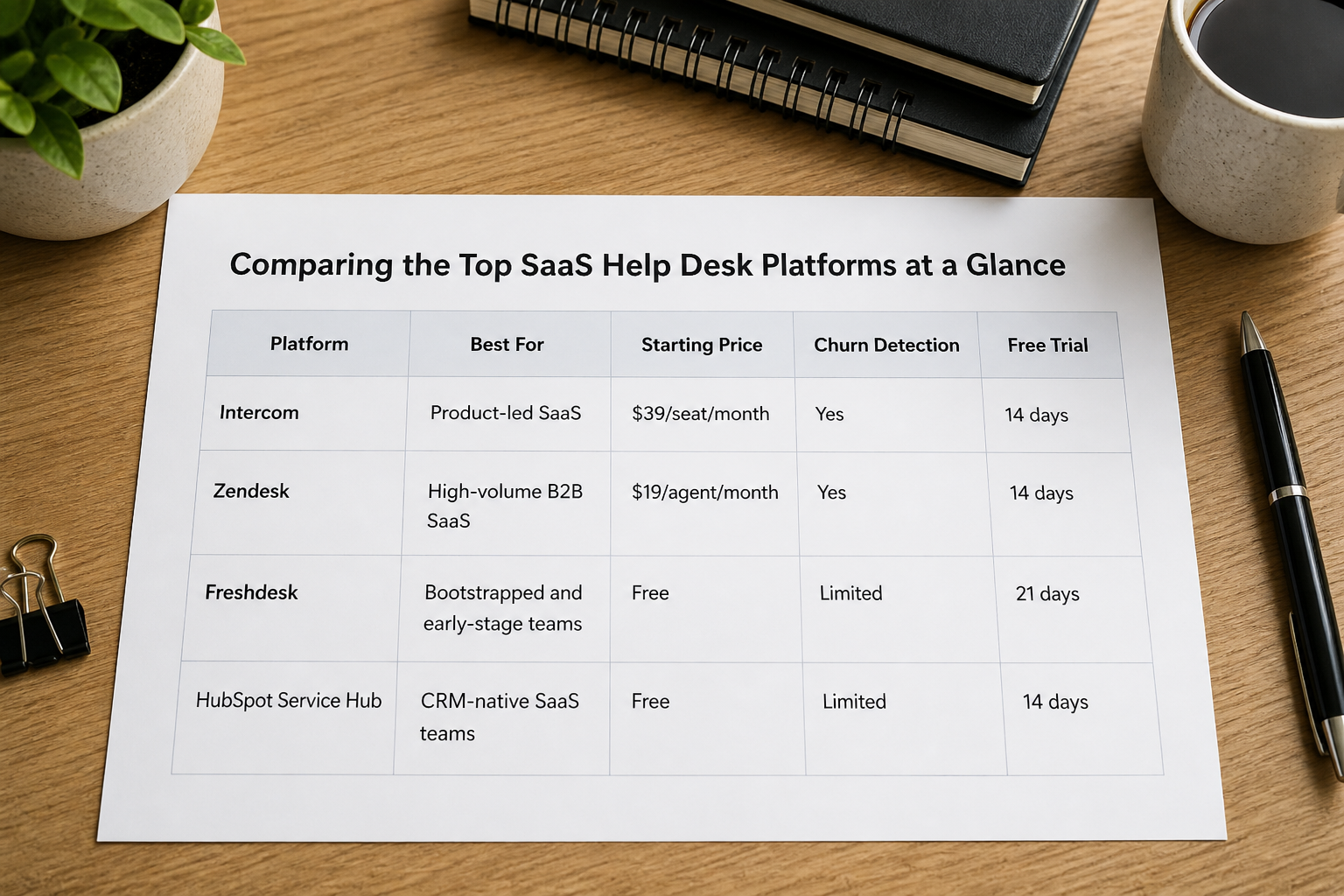
Platform | Best For | Starting Price | Churn Detection | Free Trial |
Intercom | Product-led SaaS | $39/seat/month | Yes | 14 days |
Zendesk | High-volume B2B SaaS | $19/agent/month | Yes | 14 days |
Freshdesk | Bootstrapped and early-stage teams | Free | Limited | 21 days |
HubSpot Service Hub | CRM-native SaaS teams | Free | Limited | 14 days |
Pricing reflects entry-level plans as of 2026. Most vendors offer startup discounts — always confirm directly before committing to a contract.
Choosing the right platform comes down to where your business is today, not where you hope to be in three years. Early-stage teams with fewer than 50 daily tickets need structure and the speed of setup, not enterprise-grade complexity. Growth-stage teams crossing into mid-market need automation, churn detection, and tighter CRM alignment. Enterprise SaaS teams need SLA governance, dedicated account queues, and deep integration coverage across a complex stack.
The most common mistake SaaS companies make is selecting a platform based on brand recognition rather than operational fit. A tool that works beautifully for a 200-agent B2B support team will slow down a five-person startup, and a tool optimised for early-stage simplicity will create bottlenecks the moment ticket volume and customer complexity starts to grow.
Discover key help desk features for finance teams. Improve control, tracking, and compliance with the right setup while keeping workflows simple and efficient.
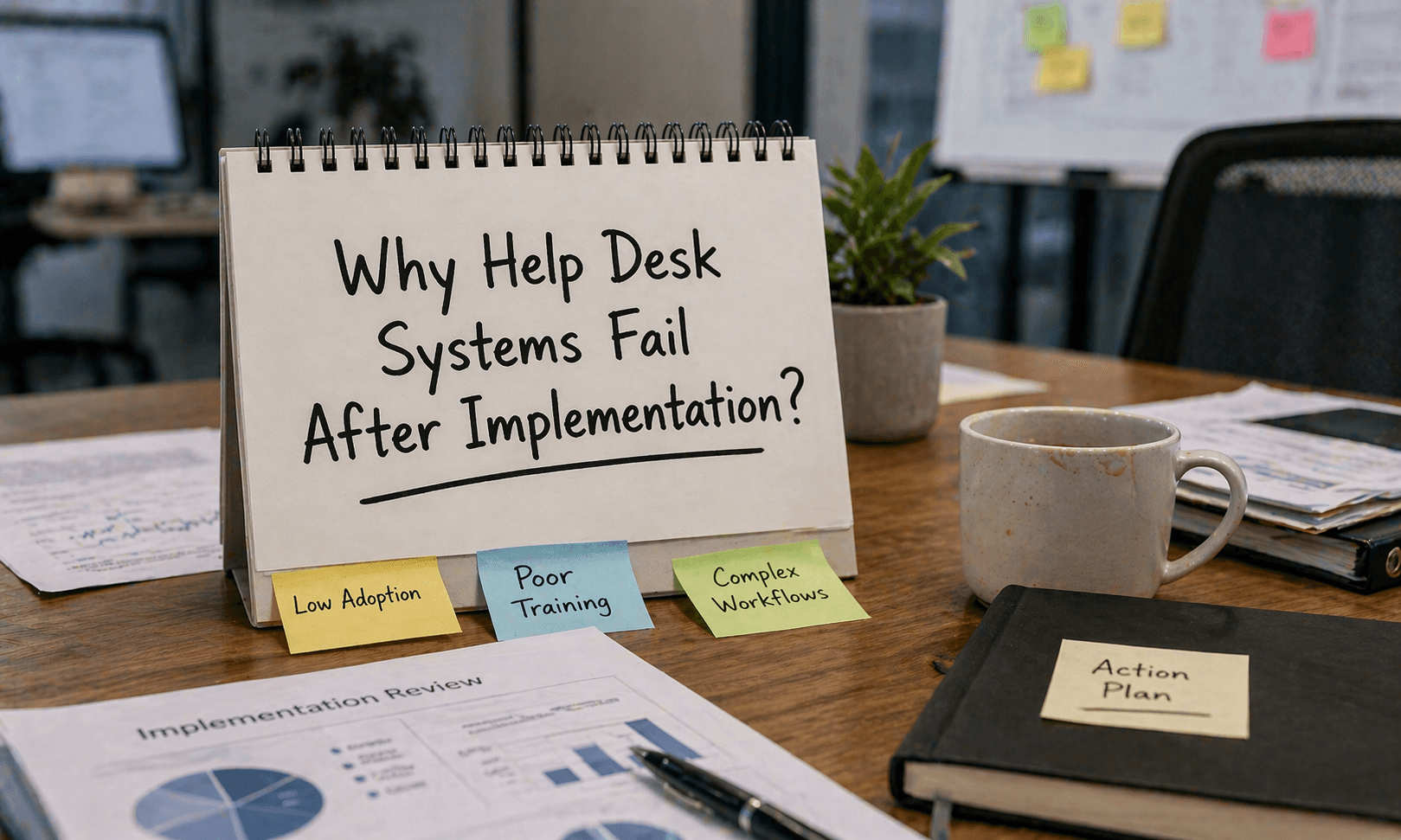
Learn why help desk systems fail after implementation. Fix adoption issues, improve workflows, and track ROI to get better results from your support setup.
Explore the best free and open source IT support tools for small teams. Manage tickets, monitor systems, and improve workflows without high software costs.

Find the best ticketing software for small IT departments. Compare tools, features, and pricing to manage requests, improve response time, and stay organized.